Translate

Showing posts with label Photography. Show all posts

Tuesday, 1 May 2018

Christina Broom: Britain's 1st Female Press Photographer


Christina Broom - Museum of London Collection
Christina Broom was credited as being "the UK's first female press photographer" and yet, despite her many achievements, her incredible life and work remain relatively unknown. “Historically she has been seen as an eccentric amateur, which has meant her work hasn’t seen the light of day in quite the way it should have done,” says Anna Sparham, who has curated a large exhibition of Broom’s photography, at the Museum of London.

Christina’s maiden name was Livingston and her parents were Scottish, although she was born at 8 King's Road, Chelsea, London, the seventh of eight children on 28 December 1862. Her father was Alexander Livingston, a master bootmaker and her mother was Margaret Fair Livingston. 

Her parents were well-off, but She must have rather exaggerated their worth, because when Christina told her fiancee, Albert, that she was not quite the heiress he thought she was, he asked her not to tell his mother. Christina’s brother Robert had already squandered much of the family inheritance at the gaming tables in Monaco, and her only income was the rent from a small house on nearby Oakley Street, which Oscar Wilde let from her to house his mother in – Broom would later testify at his trial.

Christina married Albert Edward Broom in 1889 and they had a daughter Winifred Margaret, who was born 7 August 1890. In 1903 the failure of the family ironmongery business was due to a cricketing accident which left her husband Albert an invalid after being struck on the shin by a ball. The injury was serious, causing necrosis of the tibia and fibulae bones. On the advice of a friend, the Brooms opened a small stationery shop in the middle-class suburb of Streatham. Although it never generated the income they hoped for, it was here that Christina noticed the booming trade in postcards which were all the rage. There were seven reliable postal deliveries a day; it was possible to send a card to someone in the same town and receive an answer within hours.

Christina Broom's Postcard Stall in London
Forced to become the main breadwinner for her family, Christina borrowed a box camera and taught herself the rudiments of photography when it was still very much in its infancy. She set up a stall in the Royal Mews at Buckingham Palace, selling postcards of photographs that she had taken. She maintained this stall from 1904 until 1930. 

Because newspapers were for the most part still unable to reproduce photographs, postcards were also used as a means of disseminating news, and Broom’s enterprise happened to coincide with a period of great upheaval in British history – she captured both the Suffragette movement and the First World War with an unusual, almost maternal intimacy.

She also turned her lens on the more humdrum details of city life, producing many streetscapes and informal portraits in which her sitters appear wonderfully unguarded.

Even though, by the turn of the century, photography had passed muster as a “suitable” pastime for women, most of Broom’s female cohorts preferred to operate from the safety of a studio, and to focus only on friends and family. Broom lugged her camera through the city instead, jostling for space among the male photographers of the press.

Anna Sparham says: “The testing circumstances in which she found herself stimulated her independent and resourceful qualities, but there were plenty of obstacles to overcome… conquering the apparatus was only one; having the nerve and ability to take these skills into the street, publicly projecting herself as a ‘professional photographer’, and most significantly as a woman, was another.”

When the family moved to a new house in Burnfoot Avenue, she used the coal cellar as her dark room. She was assisted by her daughter Winifred, who had left school to help and was extremely devoted for all of her life, both to the photography work and to her mother. Albert wrote the captions for the postcards in his neat script. The postcards sold well: in one night-time session Broom printed 1000.

Chelsea Barracks from Museum of London Collection
Christina was appointed official photographer to the Household Division of the Army from 1904 to 1939 and had her own darkroom in the Chelsea Barracks; she also took photographs of local scenes, including those at Buckingham Palace, as well as The Boat Race and Suffragette marches. Her portraits included  leading suffragettes such as Emmeline Pankhurst and Emily Wilding Davidson. Although Broom’s photography is immersed in an Edwardian era of grandeur and tradition,  it also conveys and acknowledges change.

Suffragettes - Museum of London Collection
 It is in her coverage of the suffragette movement that we glimpse most of her character. Although she always sought to retain a respectable impartiality in her work, here we sense a fascination and a growing appreciation. In its bright, early days the ideas must have chimed particularly with Christina’s own struggles.

When Albert Broom died in 1912, Christina and Winifred moved to Munster Road, Fulham where she took the professional name of Mrs Albert Broom. Her daughter Winnie became a VAD nurse during the First World War.

Courtesy of Museum of London
By 1915 Broom had become firmly established, selling photographs to many newspapers and magazines which featured the images of her soldier friends. Her er wartime photographs cover a huge range of subject matter from Soldiers leaving to for the front, right through to those returning wounded. She also took a rare shor of Rudyard Kipling's son John who was killed in 1915 aged 18.


Her portraits were purchased in the hundreds by soldiers who sent them home to their families; she did more for conscription, Field Marshall Frederick Roberts said, than his prayers for new recruits ever had. He was so impressed by Broom’s work that he recommended her to the King.

She attended a tea party at Buckingham Palace held for wounded soldiers in 1916 and her meetings with King George V, both before, during and after the war, would prove fruitful for her career as a press photographer. The increasingly close relationship she enjoyed with the royal family led to some of her most impressive scoops.

She was allowed great privileges and had special access to major royal events and occasions. Broom was given an exclusive commission with the Prince of Wales and produced a lovely portrait of the young prince.

Broom was the only person allowed in to see King Edward VII when he died and was lying in state. She was allowed into Westminster Abbey to photograph him at 4am in the morning. In the 1920s and 1930s her work was featured in top publications such as the Illustrated London News, The Tatler, The Sphere, and Country Life.

Christina Broom's Portrait of Pankhurst - Museum of London
   Letters and journals from the time point to Broom being accepted and respected by many of her male peers. One of the royal photographers, Ernest Brooks, gave Broom a few tips. In one note he wrote: “I am extremely sorry for you having so much worry… Hope you will soon be all right. It warrants a good nerve I know.”

The physical strain of carrying around 40 pounds worth of camera equipment across London caught up with Broom, and eventually she was confined to a wheelchair. However, if Broom found herself with crippling back pain, her daughter Winfred would push her to the barracks or the Royal Mews in her wheelchair, so that she was still able to use her camera. By the Thirties, she had closed her stall selling postcards and begun to spend more time in Margate, where she and Winnie liked to fish. 

Christina Broom died on 5 June 1939 and was buried in Fulham old cemetery. 

With the outbreak of the 2nd World War, restrictions on military photography had tightened considerably, and, despite her best efforts, Winnie found she could no longer continue running the family business. She eventually retired in Margate, where she died in 1973, but not before Queen Mary had personally recommended she save her mother’s plates for the nation. Winifred was instrumental in safeguarding Christina's negatives by having them housed in various public institutions and museums. 

Collections of Christina Broom’s photographs are held at the Museum of London, the National Portrait Gallery, the Imperial War Museum, London, the National Museum of Scotland, Edinburgh, the Royal Maritime Museum, Greenwich, the Guards Museum, London; the Royal Borough of Kensington and Chelsea Local Studies Library; the Hammersmith and Fulham Archive and the National Army Museum; Maidstone Art Gallery, Kent; and the Harry Ransom Center and the Gernsheim Collection, University of Texas, both at Austin, Texas

On 17 December 2009 a collection of some 2,000 of her photographs, mainly of military subjects, was to be offered for sale by auction at Sotheby's in London. The collection was expected to make up to £35,000. It failed to sell and was acquired privately by the Museum of London.  In June 2015, the museum opened an exhibition of her photographs entitled Soldiers and Suffragettes.

Anna Sparham for the Museum of London said: 

'Bearing in mind she's this small-framed lady working in this quite often male-dominated environment, she has this ability to really pull people together to form lovely compositions.
'She seizes their attention and you always get a sense of her relationship with her subjects, whether that's the suffragettes or powerful soldiers going off to war.'

Broom, would have needed to be quite the character herself, as well as determined, as she pursued a career that was a far cry from the trajectory expected of a woman at the beginning of the 20th Century.
 
'Christina would have had to have been quite a determined lady,she is described as quite formidable and I think to embrace the world of photography, which within her world was fairly unique, it would have been quite a brave thing to do.'


VIDEO ON CHRISTINA BROOM FROM THE MUSEUM OF LONDON


Monday, 2 April 2018

Alice Hughes, Rita Martin & Lallie Charles – Pioneering Portrait Photographers

Gladys Cooper by Rita Martin
Over the Easter Holidays, my mother and I were going through an old photo album that used to belong to my grandmother. Nestled in among the many sepia and black and white images of babies, children and family gatherings, was a beautiful hand-tinted Rotary Postcard dating from the 1920's featuring Stage and Screen Actress Gladys Cooper.

Apparently the highly photogenic Ms Cooper was one of my grandmother's favourite movie stars. When I got home I did some research and discovered that she was the subject of many picture postcards from the Edwardian era. I am now in the process of writing a potted biography of her life and career.

What interested me most about the classic vintage postcard my grandmother kept, was that the picture was credited to a female photographer - Rita Martin. I subsequently discovered that Rita was not the only female member of her family to pick up a camera and shoot "celebrity" subjects.

Rita Martin - Self Port
The Martin Family were originally from Ballymena, County Antrim, Northern Ireland. Rita was born Margaret Wier Martin on 19th July 1874 and her elder sister Charlotte Elizabeth Martin had been born on 11th April 1867. There were at least two other younger Martin sisters who were also involved in photography - Isobel and Beaulah nicknamed "Bea".

The Martin Sisters left Ireland and came to live in London sometime in the late 1800's. One of the most influential female photographers in London at the time was Alice Hughes, daughter of the portrait painter Edward Hughes.

After studying photography at the London Polytechnic Alice Huges opened a studio in 1891  in Gower Street, London. She photographed her first royal sitter, the Duchess of Fife with her baby, Princess Maud in 1893. On the expiry of her lease in 1911 she sold her business, and later opened another studio on Ebury Street, where she operated until her retirement in 1927. Hughes worked in platinotype and started the fashion for women to be photographed in large hats and evening dress in the style of the artists Reynolds and Gainsborough. Hughes also specialised in the graceful posing of mother and child groups. In her day, Alice Hughes was a leading photographer of royalty, fashionable women and children. During her most successful periods, she employed up to 60 women and took up to 15 sittings a day. Hughes refused to photograph any male subjects or have any men working in her studio.


Madame Lallie Charles -Self Portrait
 It is highly possible that both Rita Martin and her older sister Charlotte - whose professional name was Lallie Charles - worked for a brief period of time for Hughes in London where they quickly learned their craft and were inspired by Hughes' style of portraiture. 

Alice Hughes rejected the standard sepia, pictorialist view for the very expensive, beautifully rendered platinum prints in sharp focus. One of the criticisms of Pictorialism, then and now, was that the photographers frequently confused artistic excellence with vapid sentimentality. A soft focus view of a society lady admiring a tulip might sound like a good idea in theory but the result could make her look as fascinating as a blade of grass in a paddock.

Lallie Charles and Rita Martin took Hughes’ ideas further and when it came to publishing commercial picture postcards they saw the virtue in refining them, reducing background interference, or simply removing it altogether. Their success also owed as much to their ability to impart or inspire a performance for the camera, something that few Edwardian actresses had been seriously expected to do for photographs up until then.

Lallie Charles who later referred to herself as "Madame Charles" - was the first Martin sister to open her own photography studio, at "The Nook", 1 Tichfield Road, Regents Park. In 1897 her sister Rita came to work with her as an assistant, and by 1901, her younger sister Isobel was also working there, and a 4th sister, Bea Martin also helped out. 

As the prominence of female photographers grew from the Victorian to Edwardian era, the photographer H.S. Mendelsson declared in 1903 that Portraiture was "now in the hands of the women" whilst female photojournalists like Christina Bloom and Kate Pragnell were also trailblazing new techniques and styles outside of the studio.


Child Group by Rita Martin
In 1905 Lallie married 33 year old Harold Carr, who was a ladies mantle manufacturer. Their wedded bliss was short-lived however, as just 5 years later Harrold Carr died on 17th May 1910 leaving Lallie a widow. Lallie continued with her work as a photographer and by 1911 she had moved into a new studio in 39a Curzon Street, Mayfair, where Charles and Mary Leech her Butler and Cook, took care of all her domestic needs whilst she worked in the studio. Lallie's subjects were usually members of the Royal Family and notable society beauties.


In 1906 Rita had also branched out and opened her own photographic studio at 27 Baker Street, Marleybone. Rita specialized in portraits in pale colours against a pure white background. Her main subjects were famous actresses of the time, including, Lily Elsie, Julia James and Lily Brayton. Rita also photographed many children. The Actress Gladys Cooper's children were often captured by Rita's camera.


Lallie Charles and Rita Martin became two of the best-known female portrait photographers of their day - but today interest in their work is confined mainly to private collectors and they are no longer a household names despite the high standard of their images and their innovative techniques. 

Rita Martin Child Photography
A 1910 review by The Strand Magazine said "Rita Martin deserves to be singled out for praise. Perhaps a time will come when there will be annual exhibitions of the best achievements of professional photographers, as there is now for professional painters, and when that time comes the work of these artists will be highly valued by the critics. In the art of the camera as it concerns the taking of children I should put sympathy first— sympathy even before technical skill in posing and lighting."

 Rita Martin did a lot of important work with children as the subject.Her most reproduced child studies were of the Luke Children whose father, a carpenter, was responsible for building Rita's second studio at 77 Baker Street. Martin also photographed Queen Elizabeth and Elizabeth Bowes Lyon, the Queen Mother when they were both children.


Hand Tinted Rita Martin Postcard
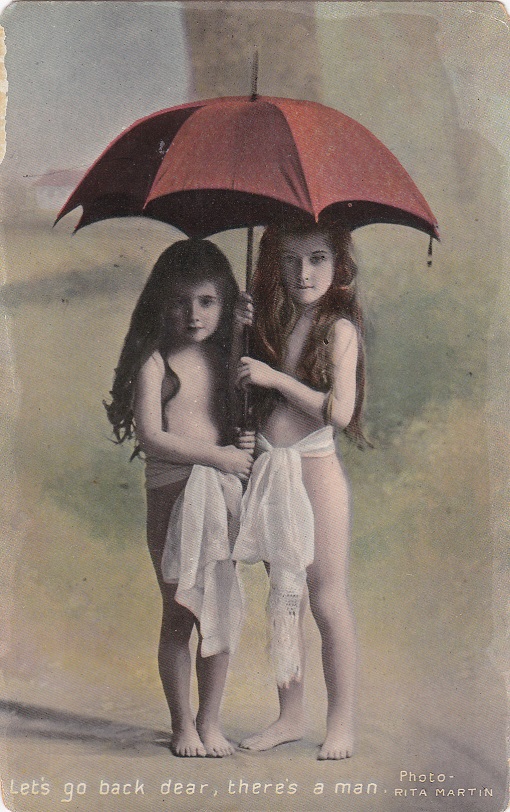
Martin’s “conventional” child portraits were distinctive as she took pains to include the subject’s hands creating a somewhat bashful appearance. Martin’s child subjects were usually accompanied by some kind of prop like a sofa, bathtub or other whimsical scene. Consistent with Victorian attitudes about the innocence of children, they were shot in various stages of undress. The artist usually refrained from giving her work titles as postcard producers would likely attach their own phrases to punch up their appeal anyway. Many images saw multiple releases in various forms—including some colorized and some in sepia.


Talking about her, Cecil Beaton said: "Rita Martin, and the pale terracotta loveliness of her photographs are part and parcel of this period. Rita Martin and her sister, Lallie Charles, the rival photographer, posed their sitters in a soft conservatory-looking light, making all hair deliriously fashionable to be photo-lowered".

With their studio's only being a a few miles apart in highly fashionable areas of London, the two talented sisters were actually business rivals, having to compete alongside the many other photography businesses run by men which were springing up all over the capital as the fashion for  having photographs taken increased in popularity.

The Martin Sisters at Tichfield Road Studio
The Photo opposite from the National Portrait Gallery database shows Lallie Charles, Rita Martin ad their sister Bea Martin in Lallie's Tichfield Road studio c1899. The furnishings and decor are typical of a high-end studio of the Victorian age, with oriental screens, rugs, vases, elaborate wooden chairs and tables and plenty of potted plants & flowers. 


In 1975 Cecil Beaton co-authored with Gail Buckland a personal history of photography, The Magic Mirror, to which he added an appendix; Commercial Photographers of the Victorian and Edwardian Era. Like the other appendices it accounted for photographers who hadn’t fitted with the general theme of the book. Rita Martin and Lallie Charles were given more attention than anyone else in this section. There’s a sense reading it that Beaton knew Rita Martin but not Lallie Charles as she died aged 55 in on 5th April 1919. Cecil Beaton intimates in his book that the two sisters fell out before Lallies death. She left £11,636 in her will - but neither Rita nor any of her sisters were left any money, so this may be true.


Rita Martin and Lallie Charles had defined for Beaton what studio portraiture could achieve. For Beaton, artificiality is a compliment. In The Magic Mirror he says of both sisters that “they transcended the stereotyped (and) showed a tyranny over their subjects, who were willing to do their bidding, for they knew they were being beautified”. Beaton could be describing his own working methods. 

Lily Brayton by Rita Martin
During the first decade of the twentieth century, photographic postcards of stage actresses were popular around the world. Most studios placed the subject before an elaborate stage backdrop, emphasizing the theatricality above the performer. Rita Martin preferred to place her women in a stark setting that obliged the viewer to consider their stage presence.


Rita Martin had a contract with the theatre manager George Edwardes that gave her rights to photograph Lily Elsie and other performers once a month. Other studios also photographed Ms Elsie. One was Foulsham and Banfield, whose work Beaton waspishly described as “rather quaint in their woodenness”. The general impression is that all power resided with management. Edwardes could agree to a regular contract, as long as Ms Martin kept her fees to a figure he thought was reasonable. A successful performer like Lily Brayton also had enough influence to ask for Rita Martin personally, and if sales of postcards justified her demands Edwardes would agree.

Although Rita Martin photographed several leading men of the stage too, of the 322 prints held by the National Portrait Gallery, only three are of men alone, and a couple are of men with their families. The number of prints is enough to be representative and suggests that like Alice Hughes, Rita Martin had principles that she couldn’t be persuaded from. The first instinct is to say these were political, but it may have been that she was essentially interested in glamour. That wasn’t a word many male actors would have wanted to be associated with in the 1910s. It implied an interest in haute couture and other womanly pursuits. When you look through lists of images of male Edwardian actors, they tend to go for either comedy or dashing but respectable, and were typecast as one or the other. Lily Brayton on the other hand could wear costumes from across the centuries and cultures and still transmit an aura of chic allure. For a photographer of the stage like Rita Martin, male actors were considered boring.

Rosamund Massy by Rita Martin
According to the NPG website, Lallie Charles photographed some of the suffragettes and Rita Martin photographed Rosamund Massy from the National Women’s Social and Political Union. Were the Martin Sisters sympathisers with women's suffrage? Were they asked to photograph these women simply because they were well-known women photographers themselves? Or was it because, like Lily Brayton the actresss, the suffragettes were part of the current cultural milieu? The answer may be yes all three questions but it’s worth remembering that while London’s theatre world might have been progressive in thought, there wasn’t a huge amount of sympathy for the suffragettes within the acting profession, especially when they started setting fire to theatres and letting off smoke bombs inside. Rita Martin may have believed that women had the right to vote and agreed to photograph some of the suffragettes but that didn’t mean she was obliged to like any of them personally or felt a desire to dedicate her photography efforts for the greater good of the cause. 

Why has the work of Lallie Charles and Rita has been forgotten today? It isn’t as if their photographs are hard to find - as a search of the internet will prove . Rita Martin was still well known in the 1940s for Cecil Beaton to assume his readers needed no formal introduction to her. Perhaps, like her sister, Rita's work is seen today as too establishment and too Edwardian for modern tastes. Her portraits of theatre stars don’t cast such a challenging light on social history like the work of Christina Bloom does.

Lily Brayton by Rita Martin
A common myth about early theatre portraits is that they were perfunctory commercial in nature and the genre didn’t take off until a handful of photographers in the 1930s (Beaton in particular) introduced an individual style. If that is the case, then portraits of Lily Brayton by Rita Martin reveal a relationship between photographer and subject that was decades ahead of its time.


Rita Martin died aged 83 in 1958. The legacy that Rita and her elder sister Lallie Charles left was that they both recognized the commercial potential of photography and became early female pioneers in portraiture. 


A few negatives by Rita Martin and Lallie Charles are preserved at the National Portrait Gallery and were donated by their niece Lallie Charles Martin Cowell in 1994, who was also photographed regularly by both sisters.

Lallie Charles Martin Cowell - Niece of Rita Martin


Featured Archive Article of the month

Christina Broom: Britain's 1st Female Press Photographer

Christina Broom - Museum of London Collection Christina Broom was credited as being "the UK's first female press photogra...

Read My Top 10 Most Popular Articles